solar panel cleaning
Does Rain Clean Solar Panels? What Fontana Homeowners Should Know
By BC Solar Solutions · · Updated · 5 min read
In this article
- The short answer: it depends on the rain
- What rain leaves behind
- Why timing matters in Southern California
- How to tell if your panels still need a cleaning
- If you're thinking about cleaning them yourself
- How we clean panels at BC Solar Solutions
- Frequently asked questions
- Ready for a cleaning after the first rains?
After a long dry stretch, the first real rain of the season can feel like a free car wash for the whole neighborhood. It's natural to assume it does the same for your solar panels. Heavy rain can do a lot of that work, but light rain cleans much less, and some messes, like bird droppings, don't wash off.
Here's what rain does for solar panels, what it leaves behind, and how to tell whether yours still need a cleaning once the clouds clear.
The short answer: it depends on the rain
Researchers have looked closely at this question, and the answer depends on how hard it rains and what's on the glass.
- Heavy rain can do a lot. The National Renewable Energy Laboratory (NREL) says in its solar maintenance guide that heavy rains give "a nearly complete cleaning effect."
- Light rain does much less. The same guide says light rain cleans much less effectively and can even make soiling worse when dust sticks to scattered water droplets. Researchers at the Cyprus University of Technology reported something similar in Cyprus: dust episodes there usually end with a light rain that sticks the dust to exposed surfaces, including solar panels.
First Solar, a solar panel manufacturer, says in the cleaning guidelines for its own modules that rainfall should be enough to remove lighter soiling at many installations, and that where soiling is heavy, properly timed cleaning can improve energy output.
What rain leaves behind
Bird droppings
This is the big one. Engineers at UC San Diego who studied soiling on solar panels in California noted that bird droppings essentially block all sunlight and won't wash away when it rains. NREL's guide also calls out uneven soiling, such as bird droppings, because uneven soiling can lead to localized hot spots on a panel.
Grime from nearby sources
Where your home sits matters. The UC San Diego researchers found that some panels were dirty enough to need cleaning because of very local conditions, such as being right next to and downwind of a highway, factory or farm field. NREL notes that soiling can often be traced to a nearby source, such as dust from a construction site. If your panels collect that kind of grime, a light shower may not clear it.
Nests and debris under the panels
Rain falls on top of your panels, not underneath them. NREL's guide points out that birds are a source of soiling and that their nests need to be removed. If birds have moved in under your array, rain won't clear out the nesting material. Our bird proofing service installs solar mesh (critter guard) to help keep birds out.
Why timing matters in Southern California
National Weather Service climate summaries for the San Diego area, and for the Far West as a whole, describe the same pattern: most of the year's rain falls in winter, and late spring through early fall usually brings little or none. So by the time the first storms arrive, panels have often gone months without a real rinse.
The first heavy storms may knock off much of that dust. Light showers can leave it behind, and rain won't wash away bird droppings. We recommend cleaning every 2–3 months in Inland Empire dust.
How to tell if your panels still need a cleaning
You can check most of this without going up on the roof.
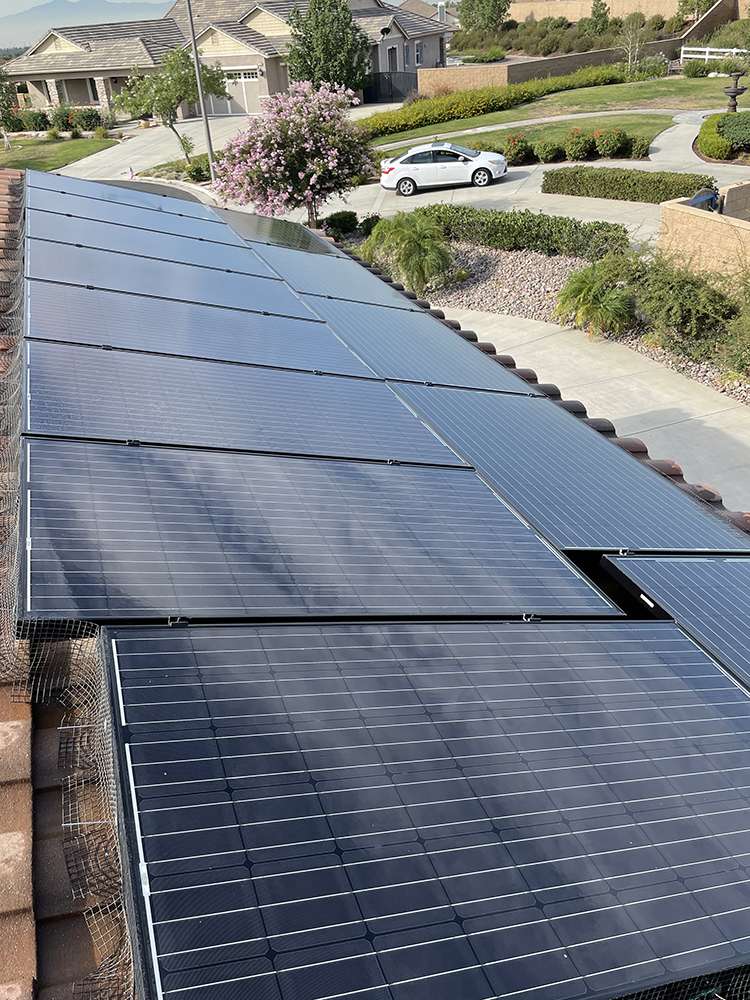
- Look from the ground or an upstairs window. White spots, streaks, a dull gray film or debris along the bottom edge of the panels are all worth a closer look.
- Check your production numbers. The U.S. Department of Energy's guidance on running solar systems says to regularly check energy production readings, and NREL notes that soiling reduces a system's energy output. If production drops and shorter days or cloudy weather don't explain it, dirty panels are one possible cause.
- Watch for birds. Pigeons flying in and out from under the panels, or droppings piling up on the roof, can mean the problem is underneath as well as on top.
If you're thinking about cleaning them yourself
Working on a roof is risky, especially on tile or a steep pitch. If you do clean your own panels, start with your panel maker's care instructions, and keep these points in mind:
- Skip the pressure washer. NREL's guide says not to use high-pressure water on solar modules, and First Solar's guidelines for its own modules also warn against spraying pressurized water directly at the junction box, edge seals and connectors.
- Watch out for hard water. First Solar's guidelines say hard water has to be squeegeed off to prevent scale buildup. NREL's guide recommends demineralized water, with a mild detergent if the manufacturer recommends one.
- No abrasive cleaners. First Solar's guidelines warn against them.
How we clean panels at BC Solar Solutions
We use deionized pure water and soft brushes, with no harsh chemicals. Cleaning a typical home takes about two hours, and each cleaning comes with an inspection plus a report. Learn more about our residential solar panel cleaning.
If you'd rather not keep track of when your panels are due, our quarterly and biannual maintenance plans keep you on schedule, with optional monthly inspections. See our maintenance plans.
Frequently asked questions
Does rain clean solar panels?
It depends on the rain. Heavy rain can rinse off a lot of loose dust, but light rain cleans much less and can leave dust stuck to the glass. Rain also won't wash away bird droppings.
Will rain wash off bird droppings?
No. UC San Diego engineers who studied solar panel soiling in California noted that droppings won't wash away when it rains, so panels with a lot of droppings should be cleaned.
How often should I clean my solar panels in the Inland Empire?
We recommend cleaning every 2–3 months in Inland Empire dust.
Can I use a pressure washer on my solar panels?
NREL's maintenance guide says not to use high-pressure water on solar modules. Check your panel maker's care instructions too.
Ready for a cleaning after the first rains?
BC Solar Solutions is family-owned since 2018 and fully insured, with same-day or next-day appointments and satisfaction guaranteed. Get a free quote or call (888) 875-6235.