bird proofing
Bird Spikes vs. Solar Mesh: Which Deterrent Fits Where
By BC Solar Solutions · · Updated · 5 min read
In this article
Pigeons on a roof with solar panels can cause two separate problems. Some land and perch on the high spots, like ridges and ledges. Others get under the panels and nest there. Bird spikes and solar mesh each deal with one of those problems, which is why the right answer is often "it depends where the birds are."
Here's how each deterrent works, where each one fits, and what to skip.
Two problems, two tools
- Birds landing and perching on roof peaks, ledges and eaves: that's a job for bird spikes.
- Birds nesting under your solar panels: that's a job for solar mesh, also called critter guard.
A spike strip on the ridge won't keep pigeons out from under the panels, and mesh around the array won't stop them from lining up on the ridge. If you have both problems, you may need both.
Bird spikes: for the places pigeons land
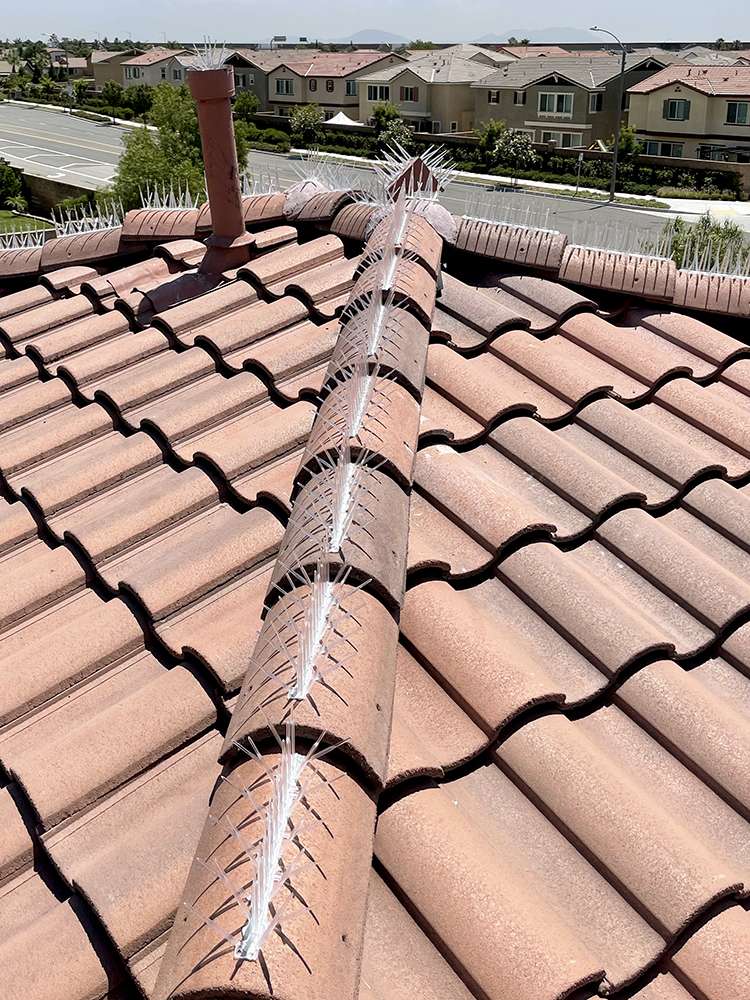
Bird spikes go by a few names, including porcupine wires. The Internet Center for Wildlife Damage Management explains that their sharp points inflict temporary discomfort and deter pigeons from landing on the surfaces they cover. It says they can be installed on window sills, ledges, eaves and roof peaks. New Mexico State University's extension guide agrees, noting that bird spikes deter large birds from landing on the surfaces they're applied to, and can be used to keep birds from nesting or roosting on ledges, rafters and other structures.
Spikes aren't meant to injure birds. Connecticut's Department of Energy and Environmental Protection describes them as a prickling fence that excludes birds without harm.
They do need some upkeep. The wildlife damage center notes that pigeons and sparrows sometimes cover the wires with nesting material or droppings, which requires occasional removal. New Mexico State's guide says nesting material sometimes has to be cleared off the spikes for them to keep working.
Solar mesh: for the space under your panels
Keeping birds out of a space entirely is called exclusion. Writing about nesting birds on buildings generally, UC Agriculture and Natural Resources calls exclusion the most effective way to keep them from becoming a nuisance, and describes it as a relatively permanent, long-term solution. Connecticut's environmental agency also says the most effective and permanent methods of pigeon control involve structural changes.
Solar mesh is exclusion built for a solar array. Unirac, a solar racking company that also sells critter guards, describes them as protective barriers, typically made of wire mesh or specialized plastic, installed around the solar array to block entry points and keep wildlife out of the areas beneath the panels. It says the two main installation methods are adhesive and clips that attach to the panel frame.
Two things make mesh work:
- Clear the space first. Connecticut's agency says nest destruction must be followed by pigeon-proofing the structure. New Mexico State's guide adds that nests should be removed so there's no nesting material left for rebuilding, and warns to make sure you're not disturbing a nest of a protected species.
- Cover the whole perimeter. In its guidance on netting buildings, UC Agriculture and Natural Resources notes that birds may simply move just beyond a netted area. An array with one open side still has a way in.
Which one fits where
- Around and under your solar panels: solar mesh (critter guard).
- Roof peaks and ridges where pigeons line up: bird spikes.
- Ledges, eaves and window sills: bird spikes, per the wildlife damage center's list.
- Both problems on the same roof: mesh around the array and spikes where the birds perch.
If you're not sure which problem you have, our post on why pigeons love solar panels covers the signs to look for from the ground.
What about plastic owls and other scare devices?
Wildlife agencies and extension guides aren't impressed. The Internet Center for Wildlife Damage Management says revolving lights, waving flags, balloons, rubber snakes, owl models and similar devices have little or no effect on pigeons. New Mexico State's guide says frightening devices have little or no effect on house sparrows and pigeons. Connecticut's agency says pigeons usually become accustomed quickly to scare devices.
Keeping it working
Whatever goes on your roof, it's worth checking now and then. Spikes may need nesting material cleared off them, as noted above. For your panels, each of our cleanings comes with an inspection plus a report, and our quarterly and biannual maintenance plans come with optional monthly inspections.
Need a hand deciding? Whether you need spikes, mesh or both, our bird proofing service handles solar mesh (critter guard), pigeon proofing and bird spikes.
Frequently asked questions
Do bird spikes hurt pigeons?
They're meant to make landing uncomfortable, not to injure. The Internet Center for Wildlife Damage Management says the points inflict temporary discomfort, and Connecticut's environmental agency describes spikes as excluding birds without harm.
Will solar mesh keep pigeons off my roof?
Not by itself. Mesh closes off the space under your panels. Birds can still perch on ridges and ledges, which is where spikes come in.
Should nests be removed before mesh goes on?
For pigeon nests, yes. Connecticut's Department of Energy and Environmental Protection says nest destruction must be followed by pigeon-proofing, and New Mexico State University's guide says nests should be removed so there's no material left for rebuilding. Some other birds that nest on homes may be protected, so confirm what's nesting first.
Do fake owls keep pigeons away?
Usually not. The Internet Center for Wildlife Damage Management says owl models and similar devices have little or no effect on pigeons, and Connecticut's environmental agency says pigeons usually get used to scare devices quickly.
Ready to keep the birds off?
We're a family-owned company (since 2018), fully insured, with same-day or next-day appointments, and satisfaction is guaranteed. Get a free quote for bird proofing or call (888) 875-6235.